The treasury management platform for Africa and emerging markets.
One position across every bank, entity and currency by tomorrow morning - approvals the server enforces, month-end that reconciles itself. From $99 a month, every module on every plan.
No money moves here - your bank stays your bank · 30-day money-back guarantee · set up in one day
The problem, honestly drawn
One of these is an audit trail. The other is how most treasuries actually run.
Treasury by spreadsheet & chat
PAYLIST_NOV_FINAL_v7 (2).xlsx · 14 tabs · shared with 9 people
Payee
Account
Amount
Approved?
Supplier A
••••3301
184,500.00
see email
Supplier B
••••4471 · edited 23:47
48,500.00
ok per Dave
Rent (Nov)
••••1180
#REF!
?
FDFinance Directoronline
Pls approve 48,500 to the supplier - acc number changed, new one is in the sheet 🙏21:47
ok approved 👍21:49 ✓✓
wait - is FINAL_v7 the final one or FINAL_v7 (2)?21:52
Untraceable edits. Anyone with the file can change any row - nobody can prove who did.
Approvals that vanish. A chat message scrolls away; the mandate was never recorded.
A position from memory. The group's cash is whatever somebody last typed in.
Audit by inbox search. When the assessor asks, the evidence is an email hunt.
The same treasury in Amarii TMS
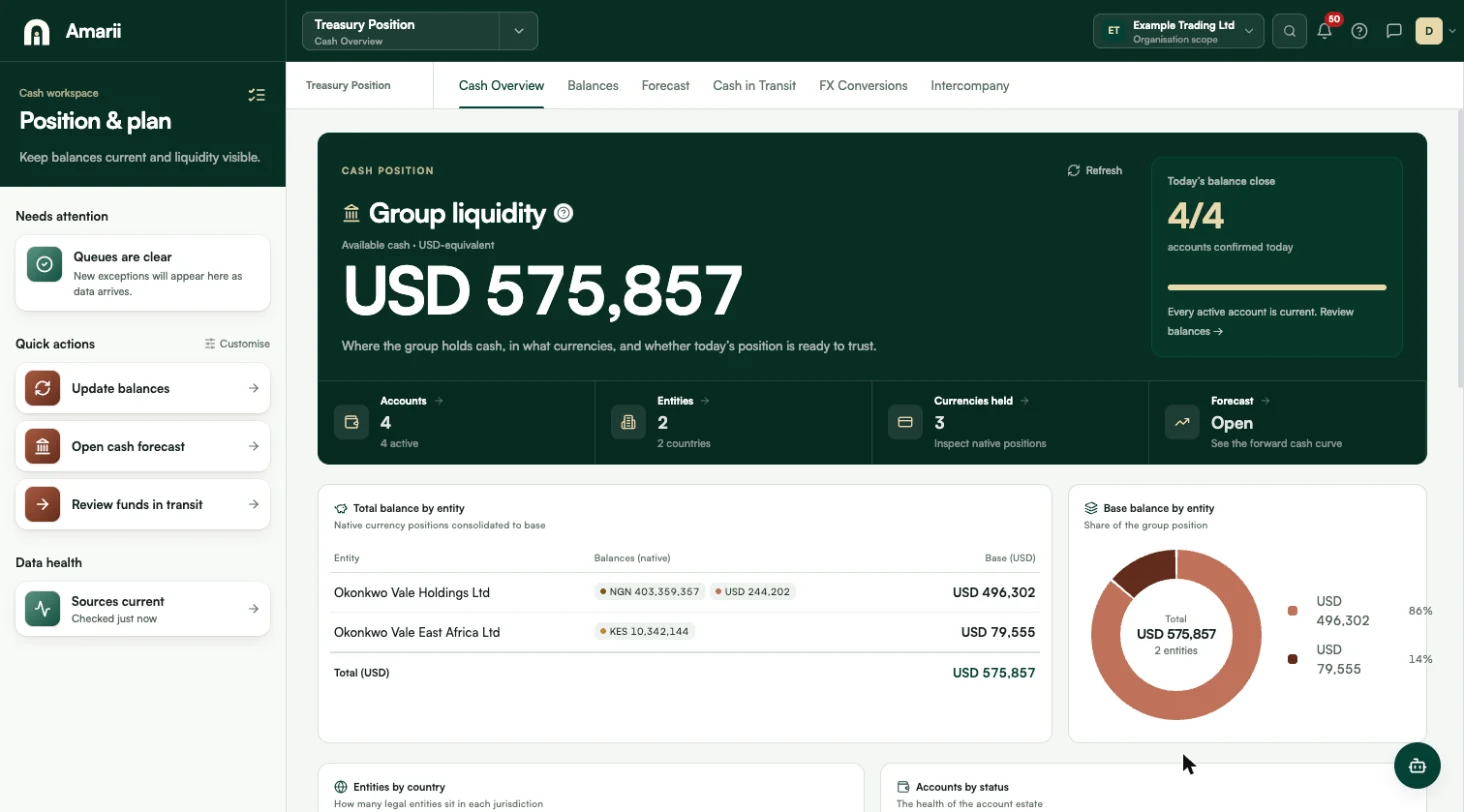
Real product screen - a demonstration company with made-up figures.
One screen, with provenance. Every account, entity and currency - each figure with its source and age.
Approvals with teeth. Maker-checker in the server: a requester can never release their own payment.
Account changes are events. Screened, audited, locked - never a quiet cell edit.
A trail that writes itself. Append-only, filterable, exportable.
The arithmetic
The big platforms sell this discipline for six figures and a quarter of implementation.
$99/month. Set up in one day.
One position across every bank. Approvals the server enforces. Scored reconciliation. An audit trail that writes itself. The same discipline the Fortune-500 platforms charge consulting money for - priced like software, because it is software.
Every account and every approval on one screen, without asking anyone. Payments above your thresholds wait for you, and nothing leaves without the chain you set.
The finance director
One position across every bank, entity and currency by morning, a decisions queue instead of a chase list, and an audit trail that writes itself.
The accountant
Statements import themselves, matching is scored with its reasons on screen, and month-end reconciliation becomes review instead of data entry.
Thirty seconds
Which plan fits your treasury?
Plans differ by capacity only - users, accounts, entities. Every module is on every plan.
How many people work inside Amarii TMS?
Internal users only - external requesters and approvers are unlimited on every plan.
How many accounts will it watch?
Bank, PSP and mobile-money accounts.
How many legal entities?
Subsidiaries, SPVs, holding companies - anything with its own accounts.
Our recommendation
Your year on Amarii TMSon annual billing - one month free · 30-day money-back · set up in one day
The enterprise platformsSix figureslicences plus an implementation project, before the consultants arrive
Every module carries a capability score. We set it, and we show our working.
The score weighs automated test coverage, live usage in beta, and whether every connector has been verified against the real thing. 4.5+ Production-hardened · 4.0–4.4 Mature · 3.5–3.9 Established · below 3 Early - and a young module says so in the product, not just here.
Modules whose pages are still in beta are labelled Beta here and in the app, and every beta section is listed, with the limits that apply to it, in our Terms.
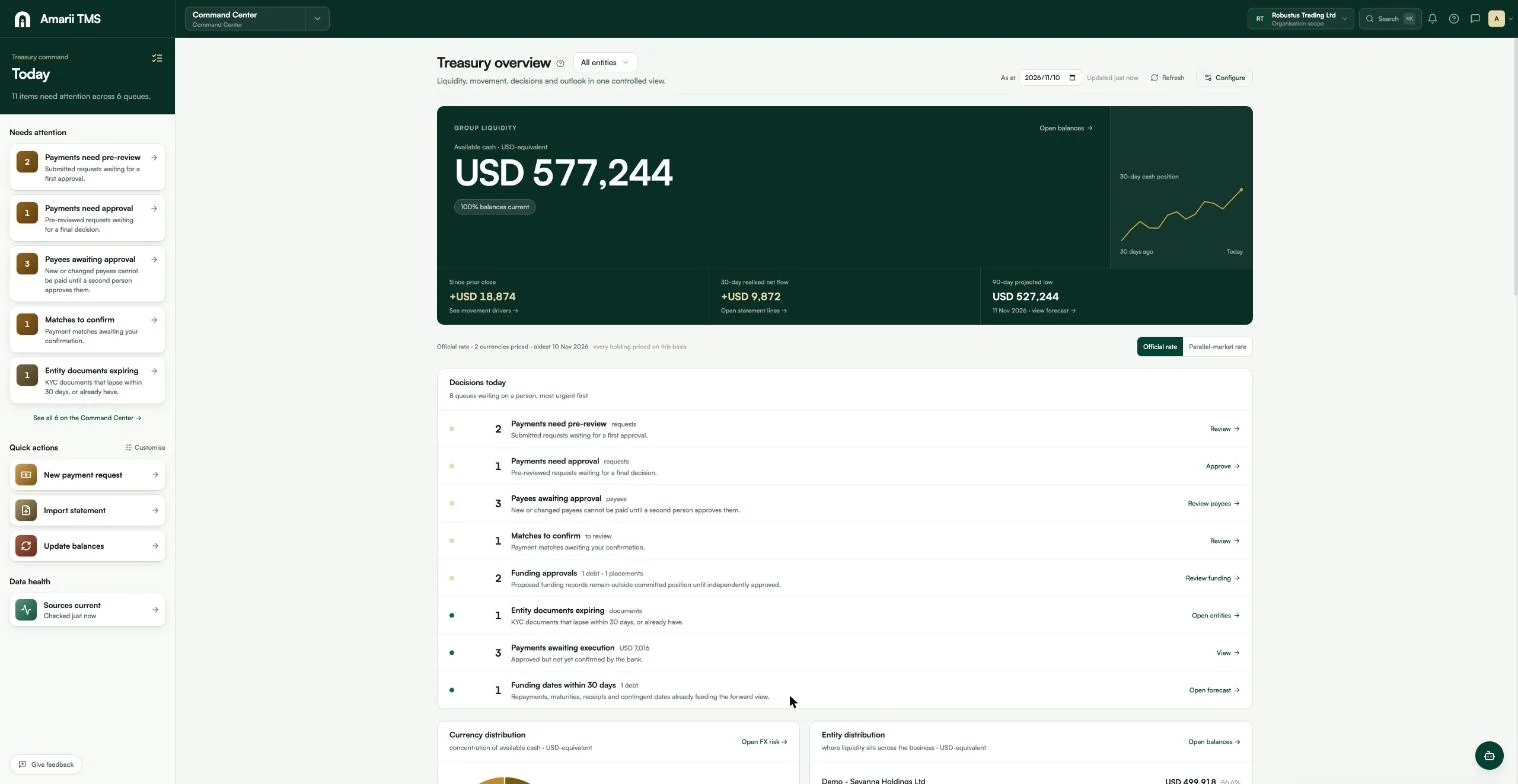
Every screenshot below is a real Amarii TMS screen showing demonstration data. No mock-ups, no renders: what you see on this page is what signs in.
01 · Command Center
Every account. One screen. No digging.
4.7Production-hardened
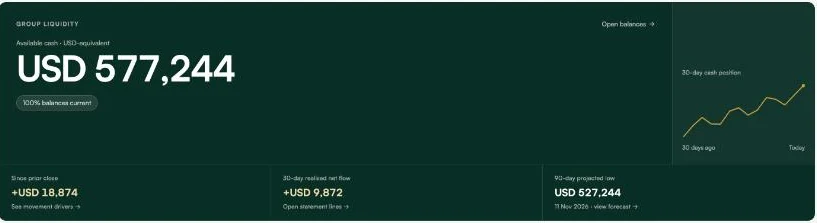
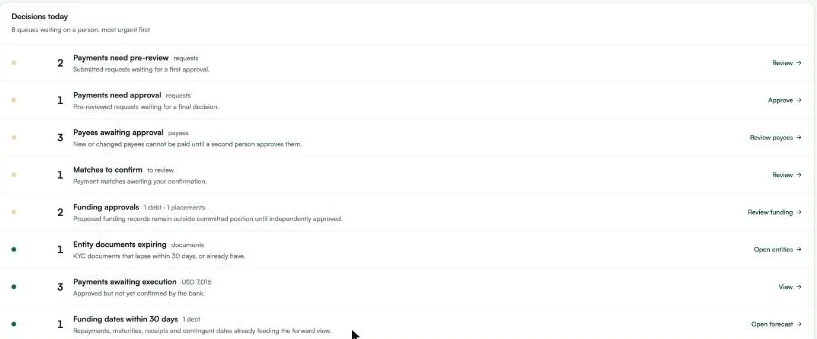
Cash across every account and currency, what needs a decision today, and what moved since yesterday - with every figure drilling down to the lines that produced it, valued on the official or parallel basis, explicitly.
Shows only what your sources delivered. Stale is labelled, gaps are named, nothing is interpolated.
Discover the Command CenterWhy 4.7: dual valuation bases, as-at history, and a decisions queue fed by every module - exercised daily in beta; the page's honesty chips are the product's oldest feature.
Real product components - demonstration data, exactly as they render in the app.
02 · Treasury Position
Where the money is, and where it's going.
4.6Production-hardened
Balances by account, a forward cash curve built from commitments (not vibes), working capital beside cash, cash in transit, FX conversions with their P&L, and intercompany netting that refuses to blur legal lines.
Scheduled flows forecast money - they never move it. A currency without a stored rate is reported, not guessed.
Forward cash curveCash in transitIntercompany netting
Discover Treasury PositionWhy 4.6: the position book, forecast engine and intercompany matrix are probe-covered end to end; planning estimates and frozen-forecast scoring landed this quarter.
Real product screen - a demonstration company with made-up figures.
03 · Reconciliation
What matches clears. What doesn't is shown.
4.5Production-hardened
Eight statement formats detected from the file itself, originals archived byte for byte, and scored matching: 0.90+ clears automatically, 0.60–0.89 goes to a human with the reasons on screen, and every automatic match can be undone.
Never auto-clears what it can't defend, and never recognises held money - a flagged credit waits for its compliance case.
8 formats detectedScored 0 to 1Every match undoable
Discover ReconciliationWhy 4.5: the scoring engine, dual-direction flows and rollback are heavily probed; external-ledger reconciliation is newer than the bank-side core.
Reconciliation by eye
Month-end by hand. Two spreadsheets, ticked row by row.
Friday matches. A near-match accepted because it is late and close enough.
Silent write-offs. Differences absorbed into round numbers, invisibly.
An unsized backlog. Nobody can say how big it is, let alone assign it.
Matching in Amarii TMS
Scored, with reasons. Every proposal rated 0 to 1, reasons on screen.
Automatic above 0.90. Clears on its own - and can always be undone.
A person from 0.60. The review lane decides; nothing below is guessed.
Held money waits. A flagged credit stays unrecognised until its case clears.
04 · Payments
Approvals here. Execution at your bank.
4.8Production-hardened
Draft → submit → pre-approve → approve → bank file, with maker-checker enforced by the server and every exemption audited. Your bank's own file layout, built from templates in plain words, every export fingerprinted with SHA-256, and requests arriving from your own systems through declared, screened sources.
Downloading a file does not send money. You carry it to your bank; the payment reference brings the statement line home.
Expense management built inMaker-checker in the serverSHA-256 on every fileScreening is the last gate
Discover PaymentsWhy 4.8: the deepest-tested module - server-enforced controls, byte-verified bank files, cross-currency sign-off and external sources all live in beta with real banks' layouts.
The Excel paylist
Anyone can edit. Any row, any amount - and nobody can prove who did.
Approval by forward. A forwarded email, if it happened at all.
Hand-typed bank files. Different for every bank, wrong in a new way each month.
No thread. Nothing links the file, the approval and the statement line.
Payments in Amarii TMS
Maker-checker in the server. A requester can never release their own payment.
One correct file per bank. Built from your templates, recorded with SHA-256.
Screening is the last gate. A flagged or unscreened row is refused by name.
The reference closes the loop. Quote it on the transfer and the request is marked paid.
Built in - no extra product to buy
Complete expense & payables management, from "can we pay this?" to paid
Beneficiaries, requesters, approvers and the money itself on one controlled line. Departments ask, policy decides who signs, your bank's file comes out the other end - and the statement closes the loop.
01
A payee is approved before a cent can aim at them
Suppliers, staff and counterparties enter a register, are screened, and are approved under maker-checker - the person who proposed a payee can never approve them. Bank details are masked to the last four characters on every external surface.
02
Anyone can ask - without a licence
Departments raise expense and payment requests through a portal, and external requesters are unlimited on every plan. A request arrives as a draft or submitted, never higher, carrying its category, entity and the account it should be paid from.
03
Approval with teeth
Maker-checker enforced by the server: pre-approval, approval, and an optional third sign-off for the categories that demand it. External approvers decide through signed links; a stage stalled past 48 hours falls to the department's backup; every exemption is written to the audit log.
04
The paylist, rechecked at the door
Approved requests group by funding account. At generation, screening and bank details are checked again, a refused row is refused by name with its reasons, and the file that comes out matches your bank's own layout - recorded with its SHA-256.
05
The statement closes it
You carry the file to your bank's own channel - Amarii never touches the money. The payment reference travels with the instruction, and when the statement lands, reconciliation marks the request paid: request, approvals, file and statement line on one thread.
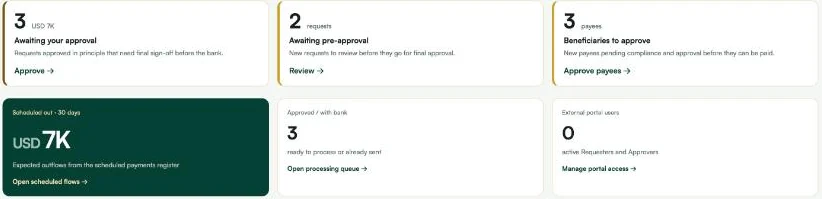
The approval desk, as it renders in the app - demonstration data.
Unlimited external requesters & approvers on every plan · screening on every payee · your bank's own file layoutSee the Payments module
Modules 05 - 10
The rest of the platform, scored the same way
Every module is on every plan, and each carries its own page: what it does, its capability score, and what it deliberately won't do. Modules marked Beta are still being proven in day-to-day use.
ISO currencies, with 0-decimal and 3-decimal minor units handled correctly - never a blanket two decimals.
8
statement formats, detected from the file's content - arriving by upload, email, SFTP, API pull or provider push.
10
modules on every plan. Pricing is capacity, never features - and a module you switch off leaves the navigation, data intact.
2
valuation bases, official and parallel, switched explicitly. An unconverted currency is reported, never guessed.
Our model
Not another fintech holding your money. The opposite.
Amarii TMS is the control layer. The structural promise: it cannot move your money, because it holds no funds, no rails and no bank credentials.
Money never moves here
A bank file is an instruction you carry to the bank. An approval is a decision recorded here, executed there.
Read-only by design
Feeds, exchanges, custody and ERP connections read and record. Keys with trade or transfer rights are never asked for.
Two people, always
A payee can't be paid and a payment can't be released by the person who created it - enforced by the server, exemptions audited.
No invented numbers
No rate on record means unconverted and reported. A connection without a live test says so instead of turning green.
Your workspace is yours
Org-isolated rows, encrypted identifiers, masked surfaces, hashed keys - and operator access only when you grant it, recorded both sides.
Honest about maturity
Every module carries its capability score, and a young module is labelled in the product - not discovered the hard way.
Pricing, published
Capacity-based. Every module on every plan.
No feature gates. Plans differ by users, accounts, entities and document storage. Annual billing is 11× monthly - one month free.
On every plan
30-day money-back guarantee
Not the system you hoped for? Email [email protected] within 30 days of your first payment and it is refunded in full - no forms, no phone call. Monthly plans cancel any time.
On every plan
Set up in one day
No integration project. Add your companies and bank accounts, upload your bank statements, and your group cash position is built the same day. Bank feeds and ERP sync can follow later.
Identity. Sign-in runs on AWS Cognito with TOTP two-step verification - required workspace-wide when your administrator says so. No self-signup: every user is invited, with their role stated up front.
Separation of duties. Maker-checker on payments and payees is enforced in the server; the narrow exemptions that keep a small business from deadlocking are written to the audit log every time they fire.
Data. Account numbers, IBANs, mobile-money numbers and wallet addresses encrypted at rest with AES-256-GCM, masked on every external surface, reveals audited. API keys and portal links hashed and shown once. Org-isolated rows, versioned document storage, hosted in AWS af-south-1 - Cape Town - with residency options on Custom plans.
Evidence. An append-only audit log you can filter and export; a system-health page where a job that hasn't run since boot says so rather than turning green; operator support access only when you grant it, read-only, recorded on both sides.
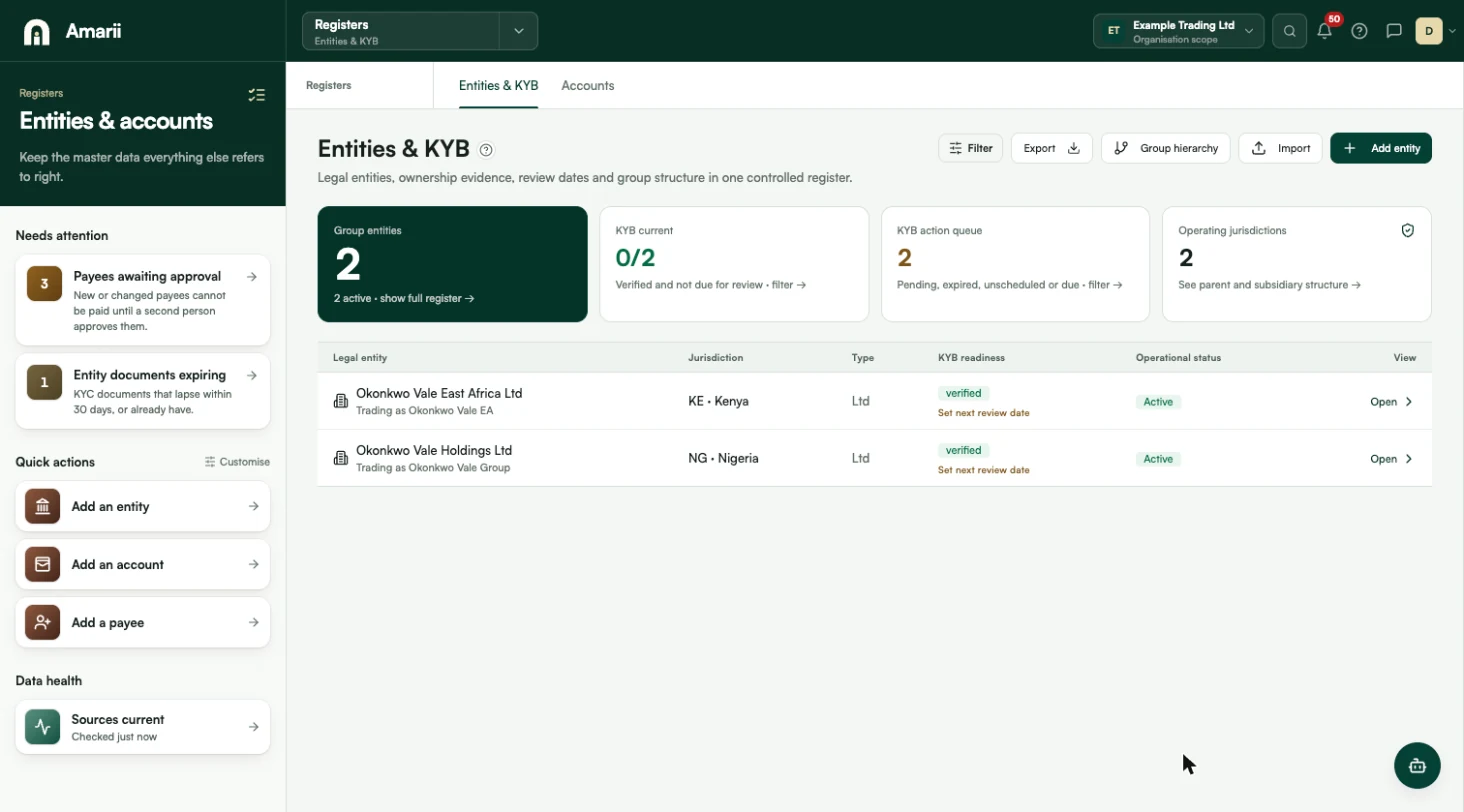
Entities & KYB - real product screen - Example Trading Ltd, the app's built-in demo company.
Questions treasurers ask
Straight answers
Is there a free trial?
No - and that is deliberate. Signing up costs nothing and shows you everything: your workspace opens read-only with the built-in example company, so you can judge the product on real screens before a cent changes hands. Paying unlocks working. Every plan carries a 30-day money-back guarantee, and monthly plans cancel any time, so the risk stays ours, not yours. Want a look before signing up at all? Open the demo - the app's own screens on a sample company.
Is Amarii TMS in beta?
Yes, and we say so plainly rather than hiding it: every module carries a published capability score, and the younger ones wear lower numbers in the product itself. Subscribing during beta is paid early access at the published prices - the same software, the same support, the 30-day money-back guarantee as your safety net. If you'd rather ask a question before putting a card down, write to [email protected] and a person answers.
How fast can we start?
One day, not a project. Sign in, name your entities and accounts, and drop in your first bank statement - the format is detected from the file itself and the position builds from there. Nothing needs integrating before you see real numbers: statements arrive by upload or email intake from day one, and scheduled SFTP, API pulls and ERP sync can follow once the basics are running. The in-app guide and the built-in example company walk you through every step.
Does Amarii TMS move money?
No, and it never will as designed. Amarii TMS records, approves, reconciles and reports. A pay run produces a bank file in your bank's own format; the bank executes it under your existing mandates and signatories. Amarii TMS holds no funds, no client accounts and no payment rails.
How does my data get in?
Statement files in eight formats, detected from the file's content and arriving however your bank can manage it: upload, email intake, scheduled SFTP, API pull or provider push. Beyond statements: ERP sync (Xero, QuickBooks, Odoo), read-only digital-asset connections, five explicit API push endpoints for your own systems - or manual entry while you're starting out. Anything ambiguous waits in a queue rather than being guessed onto the wrong account.
Who sets the capability scores?
We do, and we publish the working: automated test coverage, live beta usage, and whether every connector has passed verification against the real provider. They are our own engineering assessment, not an external certification - and the same honesty runs inside the product, where an unverified connection is labelled instead of shown green.
Do you support parallel market rates?
Yes. Rate governance holds the official rate and the parallel market side by side - live official rates from public feeds, manual entries for both bases, every value kept with its source and time. The dashboard values the position on either basis, explicitly. Parallel data is your internal reference; Amarii TMS does not republish it.
What happens to approvals started outside Amarii TMS?
Bring your own data: payees and requests can arrive from spreadsheets, an API push, a scheduled pull or an ERP. Each source declares its approval mode - the full chain in Amarii TMS, pre-approved at most from a trusted source, or (admin-only) approved outside Amarii TMS with a named approver and time. Screening is the last gate either way.
Is my crypto safe in Amarii TMS?
Amarii TMS never touches it. Wallets are watched addresses read from public chain data; if a balance can't be re-verified, the last verified figure stays, labelled with its age and reason. Exchange and Fireblocks connections are built read-only and are still in validation against the providers' live APIs - they carry that label until verification is done, which is also why Digital Assets wears a 2.5.
Can I turn off what I don't use?
Yes. Every module except Command Center, Treasury Position and Reconciliation has a switch in Settings. Off means out of the navigation entirely; the data is kept and returns when you switch it back on.
Where is it hosted?
AWS af-south-1 (Cape Town), with automated database snapshots and versioned document storage. Custom plans can discuss residency and single-tenant deployment.