Module 04 of 10 · Capability score

Payments

4.8Production-hardened

Payment requests from your team, the approvals they need, and the bank file at the end. Amarii records and approves; your bank still moves the money.

This is also your expense management: beneficiaries, department requesters, approvers and categories - the whole request-to-paid line, built in, with no extra product to buy.

What you'd do first Add an approved payee, then raise a request against them.
The flow, end to end

From "can we pay this?" to paid - who does what, and what the system refuses

  1. 01

    The payee register - beneficiaries under control

    Suppliers, staff and counterparties are proposed, screened and approved under maker-checker before a single request can name them. The person who proposed a payee can never approve them, bank details are masked to the last four characters on every external surface, and a change to a payee is an event - screened, audited, locked - never a quiet edit.

  2. 02

    The requester - anyone in the business, no licence needed

    Internal users raise requests in the app; departments outside it submit through a portal, and external requesters are unlimited on every plan. A request arrives as a draft or submitted - never higher - carrying its category, entity, currency and the account it should be paid from. Requests can also arrive from your own systems: a push, a scheduled pull, an ERP sync.

  3. 03

    The approvers - policy decides, the server enforces

    Pre-approval, approval, and an optional third sign-off for the categories that demand it. External approvers decide through signed links under the same policies as internal ones. A requester can never release their own payment; a stage stalled past 48 hours falls to the department's backup; cross-currency payments need a separate sign-off bound to the currencies it was given for; and every exemption that fires is written to the audit log.

  4. 04

    The paylist - rechecked at the door

    Approved requests group by funding account in the Paylist Builder. At generation, screening and required bank details are checked again; a refused row is refused by name with its reasons on screen; and the file that comes out matches your bank's own layout, recorded with its name, format and SHA-256. A payment already in a generated file is refused a second time until you say so.

  5. 05

    The statement - the loop closes itself

    You carry the file to your bank's own channel; Amarii has no payment rails and never touches the money. The payment reference travels with the instruction, and when the statement lands, outbound reconciliation marks the request paid - so request, approvals, file and statement line sit on one auditable thread.

Unlimited external requesters & approvers on every plan · screening on every payee · your bank's own file layout, built in plain words Get started

The pages inside

How the work gets done

Maker-checker is enforced by the server, not by hiding buttons: a requester can never release their own payment, and every deadlock exemption that fires is written to the audit log. Downloading a file does not send money - you carry it to your bank, and the payment reference lets reconciliation close the request against the statement.
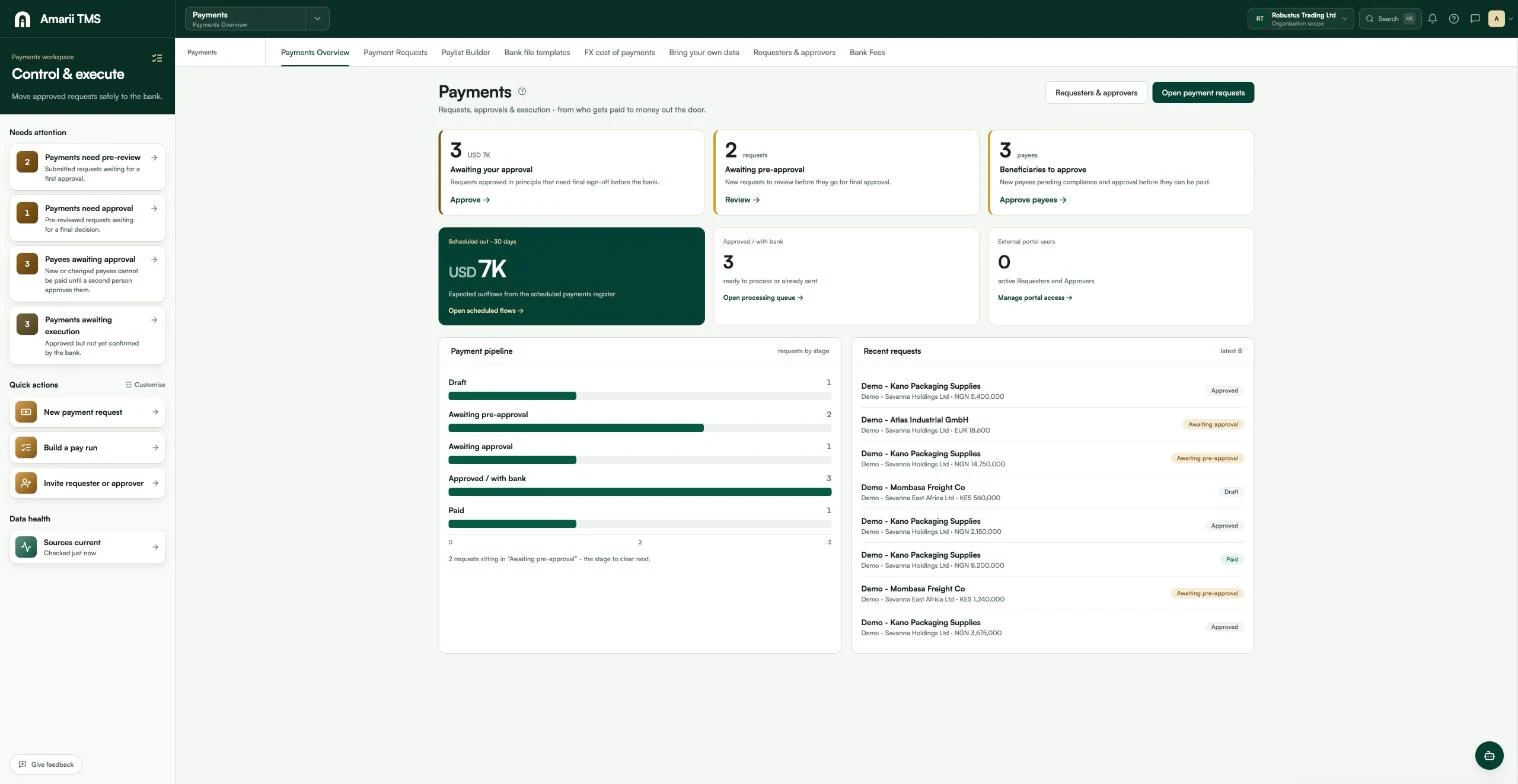
Payments Overview: approval queues, the pipeline by stage and recent requests

- What it deliberately won't do

  • No money moves here - the output is a file you carry to your own bank.
  • No bypassing the chain - an unapproved request can't enter a bank file.
  • No silent failures - a refused row is refused by name with its reasons.
On the Command CenterPayments needing pre-review, needing approval and awaiting execution sit on the Command Center's Decisions list; approved-but-unpaid requests are carried as liabilities on the position.